The Craft
Repair as Practice
Every repair we perform follows the same discipline: observe, diagnose, restore, verify. It is a sequence borrowed from trades far removed from appliance service — the patience a luthier gives a cracked soundboard, the restraint a horologist gives a stuck escapement. Nothing here is forced. Nothing is guessed.
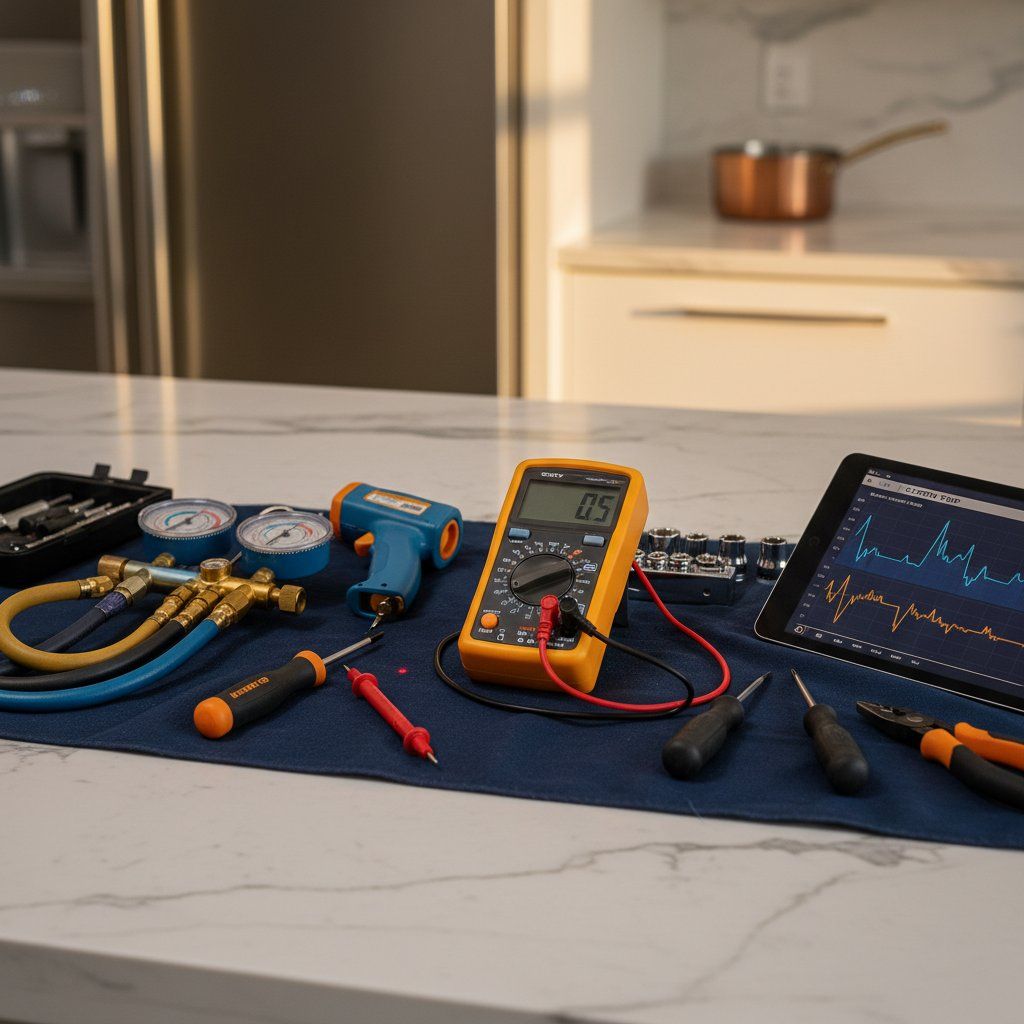
The Four-Step Discipline
A repair is not a single action. It is a sequence, and skipping a step is how good technicians turn small problems into expensive ones.
Observation
We begin by listening before we touch anything. Is the burner flame lifting and orange instead of sitting blue and steady? Is the compressor short-cycling or running continuously? Are there scorch marks around an igniter, a faint gas odor at the manifold, water pooling under a dishwasher door seal? These signs are data. Rushing past them to grab a part is how misdiagnosis happens — and how customers end up paying twice.
Diagnosis
Structured inquiry, not guesswork, using manufacturer-grade instruments. A multimeter reads microamp draw across a hot-surface or spark igniter to confirm it is failing electrically rather than just visually. A manometer checks gas manifold pressure against factory specification. A tachometer verifies convection blower RPM. Sealed refrigeration systems get pressure and superheat readings, not a guess based on a warm compartment. We are hunting for the root cause, not the symptom closest to the surface.
Restoration
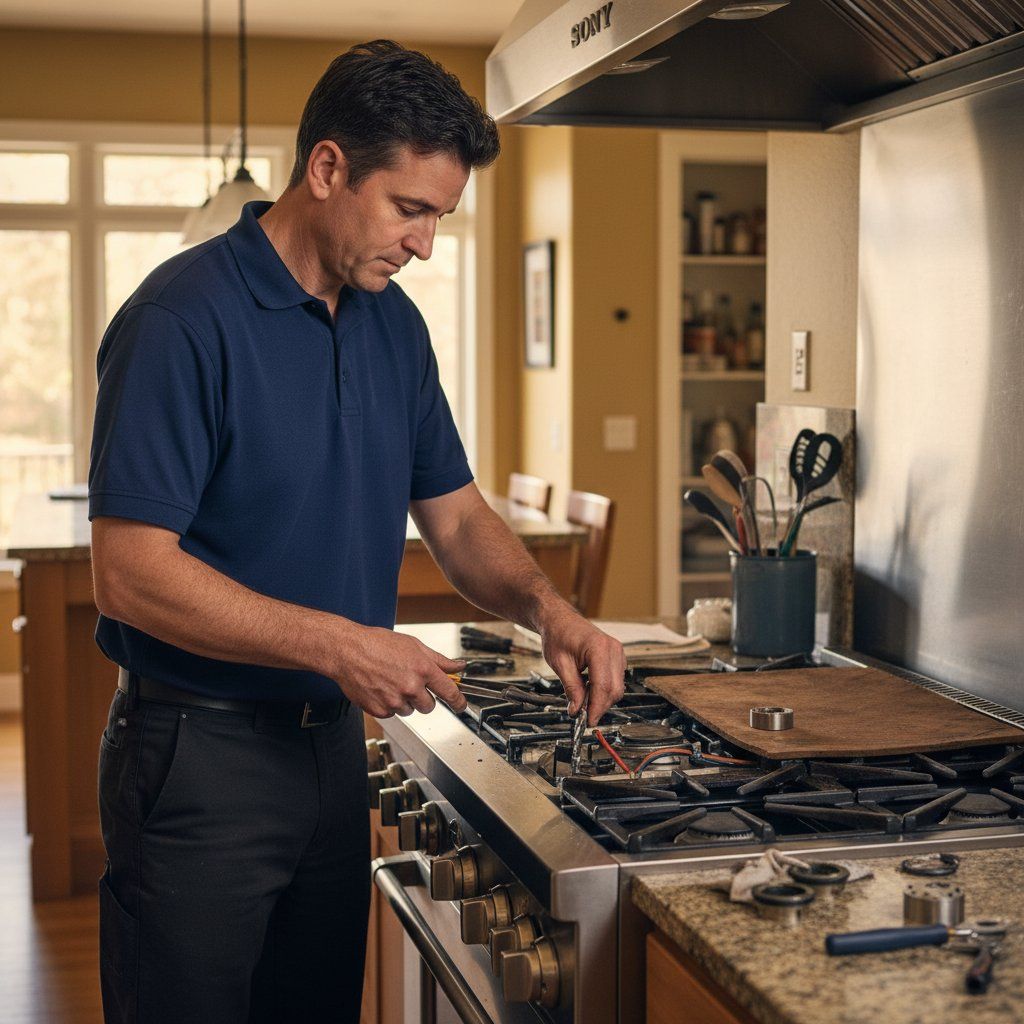
Genuine OEM parts, installed to factory torque and clearance specifications — not the cheapest aftermarket substitute that happens to bolt in. Gas orifices are sized for Boulder's elevation rather than left at sea-level factory default. Thermostats and oven control boards are recalibrated for the actual air density they will operate in, not the air density they were built and tested at. A part swap without this step is only half a repair.
Verification
Full operational testing under real load, not a five-minute glance. We time an oven's preheat and measure temperature swing with an independent thermometer, not just the appliance's own display. We watch a burner's flame pattern through a full high-to-low cycle. We run an ice maker or dishwasher through a complete cycle before we consider the job done. Everything is documented, so there is a record of what was found and what was corrected.
Altitude Changes Everything
At 5,430 feet, atmospheric pressure runs about 17 percent below sea level. Air is thinner, meaning less oxygen is available per cubic foot for combustion. Gas appliances calibrated for sea level burn rich here — flames tip orange and yellow instead of holding a clean blue cone, soot builds on burner caps and igniters, and combustion efficiency drops. Water boils at roughly 202°F instead of 212°F, which throws off any cook cycle timed for sea-level physics. Refrigeration systems see different pressure differentials across the sealed loop, which affects how a compressor cycles and how quickly a cabinet recovers temperature after the door opens.
None of this is a footnote we mention in passing. It is the reason a repair performed correctly at sea level can fail here within a season if the technician never adjusted for elevation. Every repair we complete begins with altitude in mind and ends with altitude-verified testing — burner orifices sized correctly, oven thermostats recalibrated for Boulder's air, and convection and sealed-system components checked against the pressure they actually operate under, not the pressure a factory spec sheet assumes.
What Shifts at 5,430 Feet
- Gas burners run rich without a high-altitude orifice kit, producing orange tipping and soot
- Water boils near 202°F, changing timing for anything cooked by temperature and time
- Oven thermostats calibrated at sea level read and hold temperature incorrectly here
- Refrigeration sealed-system pressures shift, altering compressor cycling and recovery time
Why the Craft Matters
Most repair calls in this industry are built for speed: a technician arrives, glances at the appliance, quotes a number over the phone before ever opening a panel, and moves to the next job. We do the opposite on purpose. Every visit starts with an $89 service call and full diagnostic, credited toward the repair if you move forward, and no work begins until you have a written quote based on what we actually found inside the unit — not what we assumed from the doorway.
That written quote exists because guessing is expensive for everyone. A control board replaced when the real fault was a failed relay costs you money and delays your kitchen coming back online. Genuine OEM parts cost more than universal substitutes for the same reason a factory-torqued bolt outlasts a stripped one — they are built to the tolerances the appliance's engineers designed around, and they hold up at Boulder's altitude and temperature swings the way a generic part often does not.
We can usually offer same-day or next-day appointments, and phone calls are answered 24/7, but the diagnostic itself is never rushed. Fast scheduling and a careful inspection are not in tension — the discipline is what lets us move quickly to the right fix instead of quickly to the wrong one.
Direct Answers
What repair process does Boulder Wolf Appliance Repair follow?
We follow a four-step discipline on every job: observe the symptoms and wear patterns, diagnose the root cause with manufacturer-grade instruments like multimeters and manometers, restore the appliance using genuine OEM parts calibrated for Boulder's elevation, and verify performance under real operating load before we consider the repair complete.
Why does altitude matter for appliance repair in Boulder, Colorado?
At 5,430 feet, atmospheric pressure is about 17 percent lower than sea level, so gas burners run rich without high-altitude orifices, water boils near 202°F, and oven thermostats and refrigeration sealed systems behave differently than factory sea-level specifications assume. A repair that ignores elevation often fails again within a season.
Does Boulder Wolf Appliance Repair diagnose before quoting a repair price?
Yes. Every visit starts with an $89 service call and full on-site diagnostic, credited toward the repair if you proceed. We provide a written quote only after inspecting the actual appliance, and no repair work begins until you approve that quote — we never estimate a price over the phone.
Frequently Asked Questions
How long does a diagnostic visit typically take?
A thorough diagnostic — checking electrical draw on igniters and motors, gas manifold pressure, thermostat calibration, or sealed-system pressures depending on the appliance — usually takes 30 to 60 minutes on site. Simple faults are sometimes confirmed faster; sealed refrigeration systems or intermittent electrical faults can take longer to reproduce and isolate correctly.
What instruments do your technicians actually use during diagnosis?
Depending on the appliance, we use a multimeter for microamp and voltage readings across igniters, sensors, and control boards; a manometer for gas manifold pressure; a tachometer to verify convection or condenser fan RPM; and pressure gauges for sealed refrigeration systems. These readings are compared against manufacturer specification, not judged by eye alone.
Do you document what you find and what you repair?
Yes. Every visit is documented — the symptoms observed, the readings taken, the part replaced, and the post-repair verification results. That record protects you if a related issue surfaces later and gives you an accurate history of the appliance.
Is the $89 diagnostic fee credited toward the repair cost?
Yes. The $89 covers the service call and full on-site diagnostic. If you approve the written repair quote we provide afterward, that $89 is credited toward the total cost of the repair. If you decide not to proceed, the diagnostic fee covers the visit and the findings we share with you.
Schedule the Craft in Your Kitchen
(720) 903-2603Same-day and next-day appointments are usually available, and phone calls are answered 24/7.
Appointment